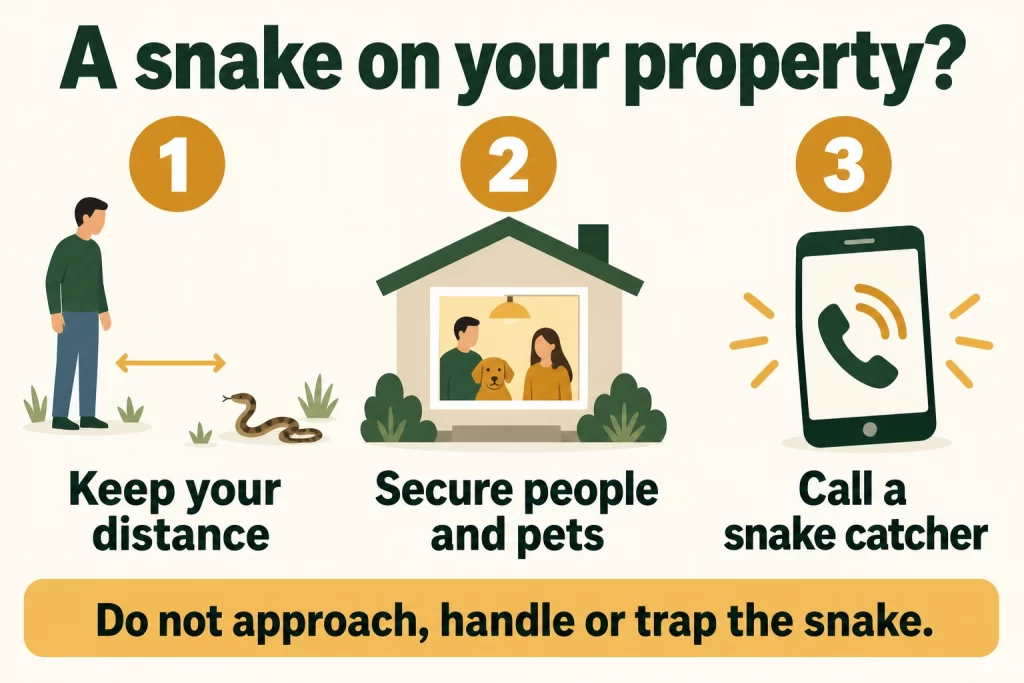
1
Move away
Bring children and pets indoors or into a closed room. Give the snake several metres of space and avoid sudden movement.

Local snake removal · available 24/7
A snake at your Toongabbie home, workplace or property needs calm, professional handling. Keep people and pets well back, maintain a safe view if possible, and call the Snakes in the City team for snake capture and removal.
Create distance first. Do not identify, corner, touch, trap or kill the snake. Never put yourself between it and an escape route.
Bring children and pets indoors or into a closed room. Give the snake several metres of space and avoid sudden movement.
If it is safe, watch from behind a closed window, fence or other secure position. Note its last-known location without chasing it.
Provide the address, access instructions, where the snake was last seen and whether it is indoors, outside, injured or trapped.
Keep the person still, apply a pressure immobilisation bandage if available, and wait for an ambulance. Do not wash the bite, cut or suck the wound, use a tight tourniquet, or try to catch the snake.
Toongabbie is an established rail-served residential area shaped by streets, homes, local shops, parks and drainage beside the Toongabbie Creek corridor. The City of Parramatta’s Settlers Walk information records a route beginning near Toongabbie railway station and following a natural creekline through Cumberland River Flat Forest. Council’s current Robin Hood Park update also confirms public reserve and bushland interfaces along Toongabbie Creek.
Creek edges, vegetated reserves, stormwater paths and the transition between established homes and nearby commercial or employment areas can offer water, prey or temporary cover. A sighting still does not mean a snake lives permanently on the property: conditions at the exact yard, shed, garage or worksite matter more than the suburb name.
Do not search by reaching into concealed spaces. These are details to report to the catcher from a safe position.
These first-hand Snakes in the City field photographs illustrate habitat relevant to the wider region. They are not records of a particular Toongabbie call-out, and species cannot be confirmed from a description alone; keep a safe distance and call for advice.
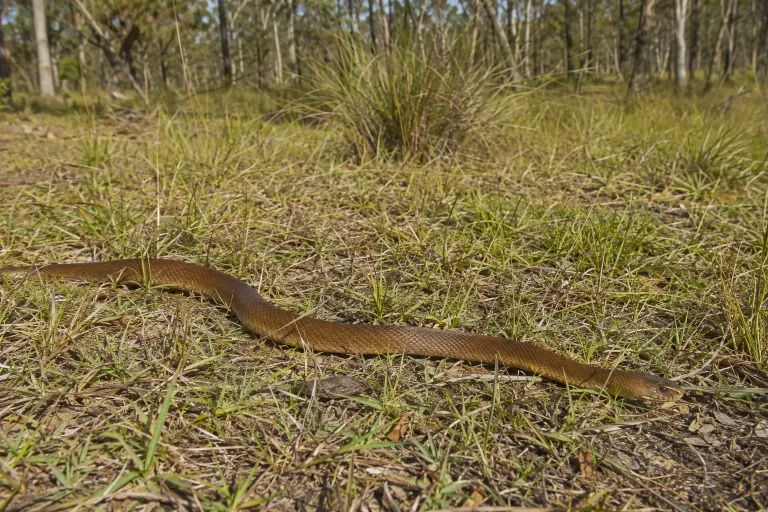
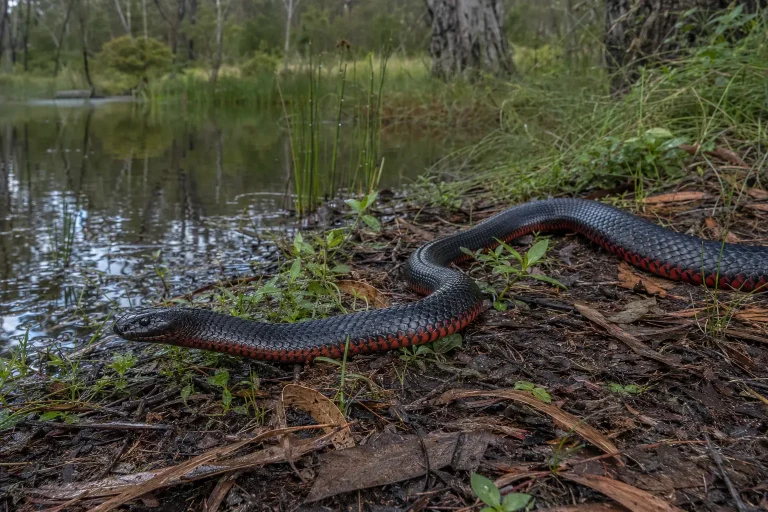
This is regional context, not a promise that either species occurs on every Toongabbie property. Never rely on colour alone: age, lighting and natural variation make quick identification unreliable.
Occurs across much of eastern Australia and can use open or modified environments where prey is available. It is highly venomous and must never be approached.
More strongly associated with wetter habitat such as creeks, drainage areas and places supporting frogs and suitable cover.
No garden design can guarantee a snake-free property. The practical goal is to reduce concealed shelter and the food sources that attract prey.
These independent services are listed for public safety and do not endorse Snakes in the City. Human snakebite and pet emergencies require different action.
Call Triple Zero (000) immediately and follow the operator’s instructions. Keep the person and affected limb completely still. Apply a broad pressure bandage over the bite and then the whole limb, and splint it if equipment is available. Leave the bandage in place. Do not wash, cut or suck the bite, use a tourniquet, or try to catch the snake.
Nearby NSW Health emergency departments include Blacktown Hospital at 18 Blacktown Road, Blacktown (switchboard (02) 9881 8000) and Westmead Hospital at Hawkesbury and Darcy Roads, Westmead (switchboard See the provider’s website for contact details). For children, The Children’s Hospital at Westmead Emergency Department provides paediatric emergency care. For a suspected bite, call 000 rather than a hospital switchboard.
Keep the pet away from the snake, restrict movement where this can be done safely, and call a veterinarian for immediate transport advice. Do not delay veterinary care while trying to identify or catch the snake.
SASH Western Sydney
1 Rowood Road, Prospect NSW 2148
24/7 emergency veterinary service: See the provider’s website for contact details
The veterinary listing is provided for location and emergency contact information only.
Call while you still know where it is, provided you can do so safely. A snake can disappear into vegetation, a roof space or stored material quickly.
Only take a photograph from a safe distance using zoom and a physical barrier. Never move closer or block the snake to get a clearer image.
If it is already inside a room and you can close the door without going near it, do so and place a towel along the door gap. Do not re-enter.
No. Maintenance can reduce cover and prey activity, but snakes can still pass through well-kept Toongabbie properties.
Give the exact address, safest access point, last-known position, whether the snake is indoors or outside, and any nearby pets, people or site hazards.
Use the guide that matches the property’s actual location near Toongabbie’s suburb edges. These links follow the verified local geography and the existing Blacktown service cluster.
This update adds practical detail for the places, access conditions and property types that distinguish this suburb. It complements the safety and service information already on this page.
Toongabbie Creek and its adjoining reserves form a real water-and-vegetation corridor through an otherwise busy urban area. City of Parramatta material identifies a creek walk beginning near Toongabbie railway station, and documents restoration work around Sue Savage Park and Robin Hood Park. These are useful facts about the landscape, not proof that a particular snake came from the creek.
The suburb also changes character quickly. There are older detached homes with mature gardens, denser housing near the station, workshops and warehouses, plus drainage infrastructure serving large hard-surface areas. Each creates different access questions. A narrow side passage may be the issue at a house; a loading dock, caged store or moving forklift may be the issue at work.
Established homes. Check the last-seen area from a distance: garden edging, stored timber, the shaded side of a shed, pool equipment and gaps below external doors. Do not reach under structures.
Units and shared courtyards. Nominate one resident or building manager as the contact. Keep neighbours out of the area and provide a unit number, entry instructions and the correct courtyard, garage level or stairwell.
Industrial properties. Stop work locally rather than trying to clear an entire site without information. Isolate the exact dock, racking run, container or fence line. Tell the catcher about forklifts, locked gates, site induction and after-hours entry.
Keep your distance and call Snakes in the City. If anyone may have been bitten, call 000 immediately.
Looking for broader wildlife context? The mapped place point for Toongabbie falls in square E4 of our 2025 Sydney-region observation report. A suburb can extend into neighbouring squares; this is an orientation guide, not a suburb boundary map.
View square E4 around Toongabbie in the observation report →
Counts apply to the whole square, not each suburb listed. A suburb appearing in a square does not mean a snake was recorded in that suburb. These are public observation records, not SITC call-outs, unique snake totals or a measure of danger.
Suspected human snakebite? Call 000 immediately.
Snakes in the City attended an Elfrieda Street property and found a red-bellied black snake in the back garden.
Read the Toongabbie garden call-out story and see the photograph