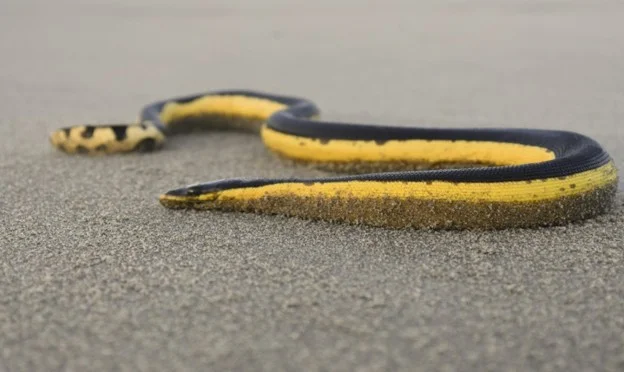
When lifesavers at a Sydney beach saw a striking black-and-yellow snake close to the swimming area, they quickly moved beachgoers back and called Harley from Snakes in the City. The unusual visitor was frightening swimmers, but the situation required more than simply moving an animal off the sand. Harley first assessed the snake, the surrounding crowd and the safest access point, then used his extensive snake-handling experience to remove it calmly from the public area. The call-out showed why an experienced Sydney snake catcher must be ready for far more than the brown snakes, red-bellied black snakes and pythons usually encountered around homes and gardens.
The animal was a yellow-bellied sea snake (Hydrophis platurus), one of the most distinctive marine reptiles found in Australian waters. Its glossy dark upper body contrasts sharply with a bright yellow belly and yellow sides, while the compressed, ribbon-like body and flattened paddle-shaped tail allow it to move efficiently through open water. Most adults are less than a metre long. Unlike a land snake, it is so highly adapted to swimming that it moves awkwardly when stranded on a beach, although that apparent helplessness must never be mistaken for harmlessness.
Yellow-bellied sea snakes spend virtually their entire lives at sea and are regarded as the most ocean-going, or pelagic, of the sea snakes. They can swim forwards and backwards, breathe air at the surface and remain submerged for long periods while hunting small fish. The species has an enormous tropical and subtropical range across the Indian and Pacific oceans, and in Australia it is recorded in coastal waters from around Sydney northwards and around the continent to Western Australia. Individual snakes sometimes wash onto Sydney beaches after being carried inshore by currents, strong winds or rough ocean conditions.
| YELLOW-BELLIED SEA SNAKE AT A GLANCE | |
| Scientific name | Hydrophis platurus |
| Appearance | Dark upper body, bright yellow underside and a flattened paddle-shaped tail |
| Typical size | Usually less than one metre long |
| Habitat | Open tropical and subtropical ocean; occasionally stranded on beaches |
| Diet | Small fish |
| Safety | Highly venomous – do not handle; call 000 for any suspected bite |
Although encounters with people are uncommon, the yellow-bellied sea snake is highly venomous and should never be picked up, pushed with a foot or returned to the water by an untrained person. A stranded animal may be stressed, cold or injured and can still defend itself if handled. Harley’s controlled approach kept the lifesavers, swimmers and snake safe while the animal was secured and removed humanely. In the event of any suspected sea-snake bite, the person should remain still, emergency services should be called on 000 and pressure-immobilisation first aid should be applied where appropriate.
This Sydney beach rescue highlights Harley’s versatility as a professional snake catcher and wildlife relocator. Whether the call involves a venomous snake in a house, a python high in a tree, a reptile beside a swimming pool or a rare sea snake on the shoreline, he brings practical experience, careful risk assessment and a calm response to every job. For fast assistance from Snakes in the City anywhere across greater Sydney, keep people and pets well away from the animal, maintain sight of it from a safe distance and contact Harley on 0412 103 488.